Join The UnCola tonight at 8 PM est on Asheville FM for another two-hour special edition of Forgotten Pop from the 70s, Vol. 23
More Posts for Show: The UnCola
The home of Asheville FM, WSFM-LP 103.3
Join The UnCola tonight at 8 PM est on Asheville FM for another two-hour special edition of Forgotten Pop from the 70s, Vol. 23
This week, two segments. The full version, with slightly more from Bernard Jemison plus Sean Swain’s segment can be found at our website.
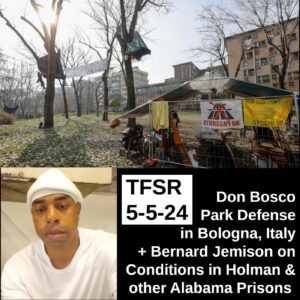 First up, an interview submitted by audio comrades in Italy about the struggle against the cementization of the city of Bologna and the defense of Don Bosco park from the expansion of a university, highways… the whole urban landscape without the input of the residents so the city can move a school rather than renovate it. This struggle, including the occupation and defense of the park, represents an innovation in urban struggles in Italy which consciously takes inspiration from the struggle to Stop Cop City in so-called Atlanta and the activities of the park defenders has forced the left-leaning municipal government and mayor to temporarily suspend the cutting of trees.
Then, you’ll hear Bernard Jemison, an incarcerated activist held in Holman prison in Alabama talking about conditions inside the ADOC recent calls for prisoner strikes in the state by the Free Alabama Movement and their outside supporters, as well as his views on the demands being made.
The demands that we mention are the following:
A few articles on the subjects worth reading include:
Social media accounts Bernard thinks are doing a good job covering these issues:
. … . ..
. … . ..
Bursts O’Goodness (co-host, producer)
Amar and Ian (co-host)
The Final Straw Radio Archives, current Audioport and Podcast. Sampling and remixing with attribution encouraged.
twitter: @StrawFinal
Mastadon: @[email protected]
fedbook: @TheFinalStrawRadio
Tumblr: The Final Straw Blog
IG: @TheFinalStrawRadio
youtube: Final Straw Channel
The Final Straw Radio
P.O. Box 6004
Asheville, NC 28816, USA
SILVER SPRING, MD – April 22, 2024 – The Centers for Disease Control and Prevention (CDC) has partnered with the National Weather Service to create a new dashboard that forecasts the daily risk for heat-related impacts in the continental United States. The announcement was made on April 22nd, ahead of the hot summer months. It can provide risk guidance for “decision-makers” and heat-sensitive populations, to reduce heat-related illness and death.
The dashboard is at www.wpc.ncep.noaa.gov/heatrisk . There is an easy-to-read color-coded map that forecasts the risk of heat-related impacts over the next 7 days.
The risk categories for heat-related impacts are:
Heat-sensitive populations include:
It is recommended that everyone take frequent breaks out of the heat and rest in a cool, shady place, drink plenty of water (at least one pint per hour), and wear light-colored, lightweight and loose-fitting clothing.
The Occupational Safety and Health Administration (OSHA) recommends that employers:
In an April 22nd press release, CDC Director Dr. Mandy Cohen said, “Heat can impact our health, but heat-related illness and death are preventable. We are releasing new heat and health tools and guidance to help people take simple steps to stay safe in the heat.”
Listen to the full report below:
Contact: Dr. Dick Needleman, Health reporter, 103.3 AshevilleFM, [email protected]
UNITED STATES – Summertime, 2024 – Heat-related illness is the nation’s leader of weather-related fatalities. About 700 people every year die in the United States from exposure to extreme heat, according to the US Centers for Disease Control and Prevention (CDC). Climate change has caused more frequent extreme weather events like higher temperatures and heat waves; therefore, people are faced with more occasions to develop heat-related illness.
People can overheat very quickly leading to potential health problems. Heat exhaustion occurs to due to loss of water and salt from excessive sweating. Signs include: headache, dizziness, fainting, weakness, heavy sweating, confusion, thirst, nausea or vomiting. People should get out of the heat with any signs of heat exhaustion. Heat stroke is a more severe condition and can be fatal. Sweating stops and the body can no longer remove excess heat. Signs include: confusion, passing out, seizures, and hot dry skin. Anyone with signs of heat stroke should be moved to a cooler place to lower body temperature immediately followed by a 911 call for immediate medical assistance.
Many factors play a role creating heat stress like environmental conditions, physical activity, clothing or protection gear, and individual risk factors. Environmental heat factors include: air temperature, humidity, local radiant heat sources, and air flow. The heat index, commonly used to measure environmental conditions, is determined by air temperature and humidity. An index above 80 is considered to be a significant minimal threshold to develop heat-related illness.
Most outdoor fatalities occur in the first few days of working in hot environments because the body has not built up a tolerance to heat. The lack of acclimatization is one of the major risk factors for heat-stress fatalities at work. Acclimatization is a beneficial physiologic adaptation of building up a tolerance to heat that occurs after repeated exposure to a hot environment.
Millions of workers are exposed to heat in the workplace and may develop heat-related illness in indoor and outdoor environments. A disproportionate number of these jobs are held by persons of color. At-risk indoor industries include: kitchens, bakeries, steel mills, manufacturing with local heat sources, and warehouses. At-risk outdoor industries include: farming, construction, landscaping, and oil operations.
Listen to the full report below:
Contact: Dr. Dick Needleman, Health reporter, 103.3 AshevilleFM, [email protected]
ASHEVILLE, NC – May 1, 2024 – The CDC’s COVID Dashboard for the week ending on April 20th shows:
Wastewater monitoring can be used to provide early warning for COVID outbreaks. The Buncombe & Henderson counties wastewater data on the North Carolina COVID Dashboard for the week ending on April 17th shows:
Listen to the full report below:
Contact: Dr. Dick Needleman, Health reporter, 103.3 AshevilleFM, [email protected]
 This week, you’ll hear our chat with Simón Sedillo, author of Weapons, Drugs & Money: Crime, Corruption, and Community Based Liberation in the U.S./Mexico Neoliberal Military Political Economy. Simón talks a little about his early days in media near the start of the Indymedia world, his documentary that became the news website El Enemigo Común (which translates to “the common enemy”) which covered grassroots, indigenous led movements in southern so-called Mexico, and about his book with a focus on intervention and integration from capitalist and military powers in the US, multinational banking and big pharma and the violence against and resilience of indigenous communities under that nation-state. The full interview can be found at our website.
Check out the website https://www.weaponsdrugsandmoney.org/ for more info on how to order a copy, and the chapters are being posted and translated into castellano at https://elenemigocomun.net/ , where you can find two decades + of really interesting content. Simón suggests people follow Avispa Mídia https://avispa.org/ as a project following in the legacy of El Enemigo Común.